The 4 basic waveforms – saw, square, triangle, and sine – have been the cornerstones of musical and other sound design for decades, be they as audio oscillators, modulators in the form of LFOs or phase modulating audio rate oscillators, or even just the effects of beating waveforms from detuning. But, the humble saw wave is likely the most-used waveform, given it’s a universal constant in most synthesizers and many synthetic musical works… but how constant is it, really?
The problem here is the saw wave was named such not due to its exact harmonic series and amplitude across the spectrum, or its shape being an exact linear shape as a real saw wave, but rather it kinda looks like one on an oscilloscope. In reality, they can differ greatly:
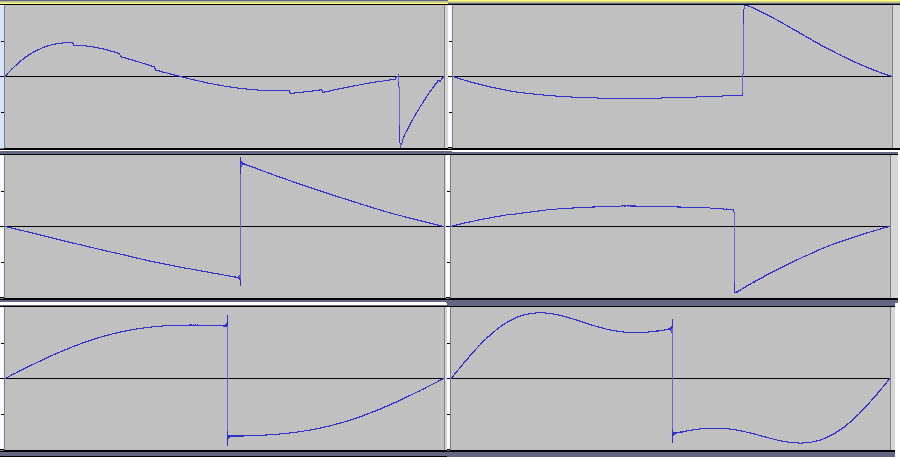
You’ll note none of these really look like what’s typically depicted as a saw wave, aside from maybe the middle left, yet all of these are considered saw waves. What’s more, they all sound different, and when used as low frequency modulators, have drastically different effects on how the sound changes over time.
What is a saw wave?
The above question may normally seem strange, but in reality is a completely valid question given their sheer variety all given the same name. To answer this, it would help to know how a saw wave is generated (finally, I get to show off my BSEE!). The simplest way to generate a saw wave is to integrate a pulse train. Basically, make a circuit oscillate such that it only creates extremely thin pulses, then use those pulses to charge a capacitor. Given the pulses are short, the capacitor has time to discharge, creating the relatively linear shape we’re used to saws having. It oscillates because the capacitor charge level triggers a comparator of some sort which creates a new pulse, and the cycle repeats.
If that’s how they’re generated, why do we see such variety? Mainly, that’s not the only way. That’s how saw-core oscillators work. Triangle core oscillators, which are equally common and found in more stable designs, use a similar system of pulses and integration, but with an equal pulse width. The pulse is then used to invert the triangle wave halfway through, creating a saw shape. Both of these can also use different kinds of feedback; for example, inversion of the saw wave that feeds back can result in a thicker, fuller, more bass-heavy saw than a positive feedback saw. Even the waveshaper that creates the saw can vary. There are of course other ways, but I’d like this to not turn into a tech column – plenty of information online on that, if you’re interested.
Along with different oscillator designs, different parts of the synth have an effect as well, from the mixer to the filter and even the vca and any effects. Even if they’re fully open, they can affect the sound and shape ever so slightly, resulting in the variety we have.
So, what does this variety mean?
The real problem here comes when trying to recreate sounds. You’ll often see people respond to such requests with, “run run a detuned/super/unison saw into a…” and rarely is much detail given on the shape of the saw, which can make or break the recreation process. As a positive, it’s also important in terms of general sound design, as different saw shapes can add a unique flair to otherwise mundane and normal sounds, especially as modulators.
I would also like to point out how this kind of thing can be said about basically every waveform. Square waves, triangle waves, especially sine waves vary greatly, some of which for reasons beyond which the length of this article goes into, such as how pulse width works and how squares can be generated post-core, how triangle waves can work without integration, and how sine waves can be everything from the core of the oscillator to a clipped and integrated triangle. I’ll leave the rest of the research up to you. Learning is more fun when you do it yourself rather than get information spewed at your face.
Happy synthing!
 Taika Sound Design
Leave a comment