When I tell people I do sound design using synthesizers, I usually get one of 3 responses: “show me what you’ve done,” “how?” and “what’s a synthesizer/what’s sound design?” That middle one is what today’s post is about: how exactly do you synthesize real sounds using synthesizers?
What defines a synthesizer?
It’s first worth pointing out the massive differences between what most people think of as a synthesizer, and what I use as a synthesizer. Most people think, because most synths are designed as such, that a synthesizer consists of oscillators producing basic shapes, mixed together into a (usually lowpass) filter, controlled with some envelopes and maybe an LFO, like a Prophet or Minimoog. Some people may be more attuned to modern synthesizers that employ wavetables and complex filters and modulation with effects built-in, like Hydrasynth or Vital.
What I use is nothing like those at all. I use this:
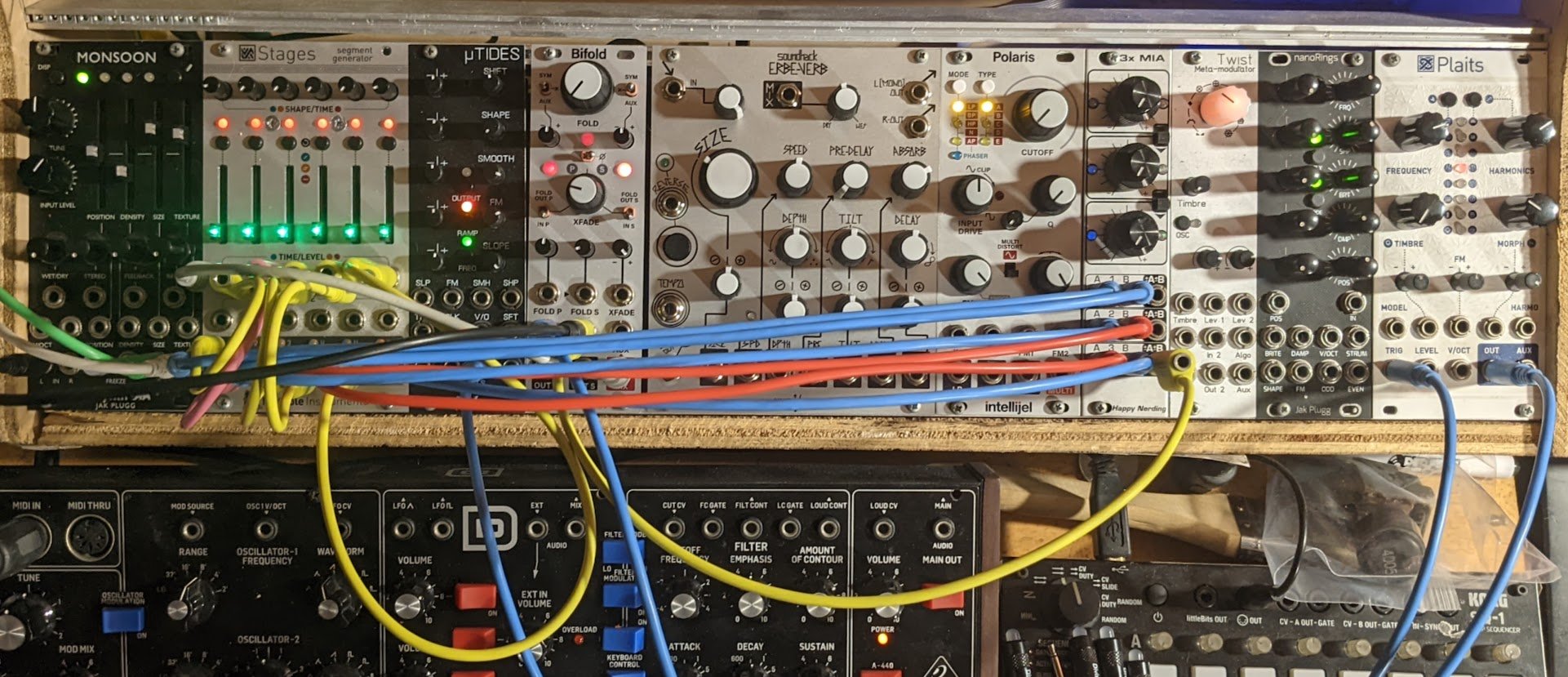
This is a modular synthesizer, specifically in the Eurorack format, though many other formats and infinite configurations of each exist. Being modular means you can swap out components as you wish; so, using a normal synth as an example, I can swap a basic shape oscillator for a wavetable oscillator, I can swap a lowpass filter for a state variable filter, etc. Except, the world of modular synthesis goes far beyond the scope of traditional synthesizers, offering extreme levels of flexibility and choice for every aspect of the synth. It gets weird enough that you can technically make a system composed entirely of envelope generators and an extremely wide variety of tones from it.
Soooo what’s it do?
Almost every module in my rack, both those pictured above and those I have available to swap in as needed, can do many things, often at once. From right to left: Plaits offers 16 different synthesis algorithms in one; Rings is a modal resonator and multiFX unit; Twist (based on Warps) is 8 different effects based on two signals’ interactions, as well as 8 other effects; 3xMIA allows for addition, subtraction, attenuation, inversion, and more; Polaris is 26 different filters with distortion in 1; Erbeverb is a hyper-complex reverb; Bifold is a dual wavefolder and crossfader; Tides is a complex waveshaping envelope generator and LFO; Stages is 6 of whatever you want, from VCOs, LFOs, envelopes, random sources, quantisation, and more; and Monsoon is a granulator with some alt modes built in.
That barely scratches the surface of what any of these modules can do, but you can see how powerful even a smaller system like mine can be, especially over traditional fixed architecture synthesizers.
I barely know what that all means, but go on, tell me how to make realistic noises with it.
Sound design using modular synthesis is often a very involved process, especially when making more mundane and realistic sounds. While a lot of my professional work revolves around using libraries of samples, I’m regularly synthesizing sounds I can’t get a good sample of or that I need more control over. Most real sounds are very easy to recreate using 4 things: noise, granulation, reverb, and filters. Some examples:
Footsteps: Starting with pink noise, as many realistic sounds do thanks to its dull yet spectral nature, allows us to sculpt a wide variety of sounds. In this case we’re putting it into a dull-sounding modal resonator, essentially a 64-channel bandpass filterbank within the feedback loop of an audio-rate delay, but with the filters arranged such to make a sort of woody, lowpassed sound. That goes into a voltage-controlled granulator which is modulated by a decay-only envelope generator, making multiple randomised decay ‘plucks’ simulating the multiple layers of snow one typically steps through when walking on snow, or the many smaller rocks when walking on gravel, or the smaller grains of sand, or a variety of other rough materials. Each footstep, or group of randomised plucks of resonated noise, gets slightly panned left or right, then through a reverb.
That general patch of noise->filter->granulator->reverb is extremely useful for a wide variety of sounds, especially of the earthy variety but also for creaky doors and other things. If you have all four, I recommend trying it out and seeing what sounds you can achieve. Sometimes I use white noise into a granulator to make particle noise (or use the particle noise generator on Plaits), then filter, granulate, and reverberate that.
Loon or other birds: mix highpassed noise with a basic 2-operator FM synth, then run that into a lowpass filter, reverb, and a resonator (audio rate delay with minimal feedback). The important part with this is how you control pitch, volume, and timbre via FM amount. Typically you’d want to match the animal in question, so for example with a loon, you would want an envelope like this (using Phaseplant from Kilohearts):
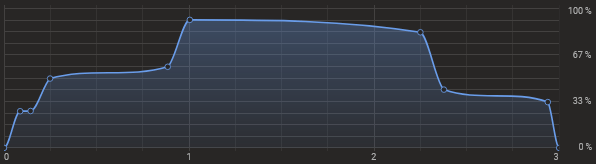
Other animals, like seagulls, crows, etc., will involve very different envelopes, but a similar synthesis method.
Fire: Use a digital noise source (I like Telharmonic from MakeNoise) to create a sort of tonal noise, then send it into a resonant lowpass filter with random smoothed cutoff modulation, then distortion. mix that with particle noise into an asymmetric bandpass filter (I like the 3A1L filter from Doepfer’s A-106-6) with cutoff randomly modulated as with the other filter. That is then granulated, recorded, layered in Phaseplant (pretty much the only software synth I use, and it’s mostly used for processing samples of the modular) , wavefold the highs, compress the lows, and then EQ’d and reverb added to simulate the space the fire is in.
Wind: Run pink noise into a resonant lowpass with smoothed random cutoff modulation, then mix it with slightly tonal noise from the fire patch but with with pitch modulated by the same smoothed random source as is modulating cutoff, then send into the same 3A1L filter left static just to tame the highs and lows. That mix is then sent into a granulator. Again, record that a few times and import it into PhasePlant (are you starting to understand my workflow yet?), add a resonator set to a low pitch and square instead of saw wave, compression, reverb, EQ to tame it, and a formant filter being randomly modulated to simulate howling through trees.
Racecar: There’s a lot of ways I’ve used to synthesize cars and engines. My latest is using a hand-drawn, complex waveform mixed with noise and a synchronised sine wave into distortion and a highpass filter, reverb, and a pitch shifter at 50% mix. The drawn waveform is the heart of the sound, and really just go crazy with it. The sine is for low-end, the noise is for high end and to emulate induction/exhaust noise. You want to modulate everything, pitch, distortion level, noise level, etc with a stepped ramp LFO in time with what’s on screen. for the transitions between steps, I like to add a little sinusoidal shape to simulate gear shifts altering engine RPM. You may find that very slight phase modulation from the noise to the drawn wave adds a lot as well.
Beer pouring: like the fire patch, use digital noise mixed with particle noise into a granulator, 3A1L filter (i really like that filter lol) modal resonator, and an envelope follower following the grains and modulating the filter and digital noise pitch. Amplitude modulate the sound with bandpassed noise, then add reverb, compression, and EQ to taste.
Gunshot: probably the easiest one despite being a common sticking point for sound designers, this one’s literally just a pink noise burst into Erbeverb. It’s powerful enough to simulate spaces with astounding accuracy, from gun ranges to small rooms to open fields and canyons. A few variations of that layered will give you amazing results (featuring my anvil sample pack to emulate bullet shells):
Underwater hit: This one’s easier than the gunshot: pink noise burst into a long reverb, then a lowpass filter with fairly low (sub 1khz) cutoff.
That’s… kinda cool. How can I learn to do this?
I’m in the process of creating a video series on synthetic sound design, but the easiest way to jump into it is download VCV Rack and a few basic packs like Audible Instruments (clones of Mutable Instruments, which make up a lot of my rack) and start experimenting, maybe with the above patches. It’s totally free and extremely powerful. Be sure to read manuals for the modules you’re using to fully understand them and how they’re used!

 Taika Sound Design
Leave a comment