For the last 26 weeks I’ve maintained a series on the Wiggle Room discord server where every week I post a new synthesis technique. There have been several miniseries within the series of posts, and while new ones aren’t stopping, I figured it’d be useful to archive them all in one place. What better place than here? I’m reposting in their entirety, including boilerplate text, images, links, et al so the experience here is largely similar to on Discord when they were live. Also makes it easier to just copy/paste them lolz
1osc subtractive (moog)
Hello and welcome to the first of hopefully many synthesis techniques challenges! In this weekly series we’ll explore the myriad of ways one can synthesize sound, starting simply and getting more complex as we go. There’s no prizes or anything, these are just so you can better learn your tools and maybe learn some new things in the process.
This week, we’ll start relatively simple: an oscillator, and a filter. The basics of subtractive synthesis. Feel free to use any synth for this as long as you only use 1 oscillator and 1 lowpass filter. This is the time for your mother32, 303, juno series, polysix, roland’s SH series, korg ms-10, whatever you’ve got to really shine. All I’m asking for in reply is a audio clip utilising a single basic oscillator and a single lowpass filter – anything additional to that is allowed, from sequencing to effects to complex modulation.
The principle behind this synthesis method is simple: the oscillator creates a sound, and the lowpass filter removes the high frequencies. Most single-osc synths can only make saw, square, or sometimes triangle waves, and the lowpass filter’s cutoff frequency is modulated by either an envelope or LFO. They usually employ a VCA controlled by an envelope as well. These synths can’t make use of sync, FM, ringmod, or other multi-oscillator techniques, so they have to rely on sounding phatt with basically no parts.
Please, don’t use things like Plaits’ 1st mode or Quadnic’s mix out and say it’s just one oscillator. Also, try to keep it simple, so no wavetables, waveshaping, resonators, anything like that. Those will have their chance soon enough 🙂 Have fun, and I’ll have a new one next Saturday!
2osc subtractive (with sync and other filters, no fm yet)
Hello and welcome to the second synthesis techniques challenge! In this weekly series we’ll explore the myriad of ways one can synthesize sound, starting simply and getting more complex as we go. There’s no prizes or anything, these are just so you can better learn your tools and maybe learn some new things in the process.
This week, we’ll build on what we did last week and branch out into more complex and typical subtractive synthesis: multiple oscillators with multiple filter types. Feel free to use any synth for this as long as you only use up to 4 oscillators and 2 filters. This is the time for your mono/poly, jupiter 8, wasp, 2600, minimoog, MS-20, whatever you’ve got to really shine. All I’m asking for in reply is an audio clip utilising the above – anything additional to that is allowed, from sequencing to effects to complex modulation. I realise I could restrict this to 2-osc, 1-filter synths, but I wanna play with my mono/poly and 2600 and minimoog so yeah 🙂
The principle behind this synthesis method is, along with the stuff from last week, you now have access to detuning, chords, FM, ringmod, sync, and probably other fun stuff I’m forgetting. This allows them to sound very lush and full, or achieve crazy waveshapes and timbres, very easily. Processing those with any multi-mode filter adds a whole other layer to the sound design possible with such synths, but in this I’m allowing up to 2, which also means you can do serial or parallel filtering with separation effects and more. Please note, if you’re using a modular synth, QPAS and Dipole are 4 filters, not 2. Can’t imagine many others being confusing, but you get the point: 2 filters, 4 oscillators, have fun.
Please, try to keep it restricted to analog or emulations thereof, so no wavetables, waveshaping, resonators, anything like that. Those will have their chance soon enough 🙂 Have fun, and I’ll have a new one next Friday!
waveshaping
Hello and welcome to the third synthesis techniques challenge! In this weekly series we’re exploring the myriad of ways one can synthesize sound, starting simply and getting more complex as we go. There’s no prizes or anything, these are just so you can better learn your tools and maybe learn some new things in the process.
This week, we’re going in a totally different direction but i promise it ties into the progression of techniques: waveshaping synthesis. This is a form of distortion synthesis where you use waveshapers to synthesize sound, rather than multiple oscillators, filters, etc. Simple forms of this include wavefolding and distortion, but can also include comparator summing, saw animators, wave multipliers, segmented processing, window shaping, and more.
The principle behind this synthesis method is that you can apply various distortions to a simple wave to not only change harmonic content, but also dynamics. Similar to how lowpassing a saw wave changes overall harmonic content and volume, so can waveshaping a sine wave. This is because most waveshapers are gain-based, so more gain = more shaping, which also means no gain = no waveshaping = no signal. Very interesting tool to use, and likely will feel almost unpredictable to many as it’s not a common way to synthesize sound. End of chain effects are welcome.
Please, try to keep it restricted to waveshapers processing single basic shapes only, so no filters, wavetables (unless built into your window shaper), resonators, multiple oscillators, phase modulation, FM, AM, sync, vocoders, LPGs to form a west-coast voice, anything like that. Those will have their chance soon enough 🙂 Have fun, and I’ll have a new one next Friday!
4-op fm
Hello and welcome to the fourth synthesis techniques challenge! In this weekly series we’re exploring the myriad of ways one can synthesize sound, starting simply and getting more complex as we go. There’s no prizes or anything, these are just so you can better learn your tools and maybe learn some new things in the process.
This week, we’re exploring what’s been called the most complicated and hard to use synthesis method: FM synthesis. Like last week, this is a form of distortion synthesis, but instead of directly shaping waves based on voltage thresholds, we’re modulating the phase of waves with other waves. Phase is separate from frequency and amplitude, but still makes up an important part of any sound. Modulating phase introduces a variety of interesting artifacts which can create timbres reminiscent of additive, wavefolding, and even subtractive synthesis – which makes it very efficient as well, in the right hands.
Originally designed as an analog system like in subtractive synths and used in radio in the 60’s by John Chowning, the modern FM synthesis was created by Yamaha and designed to sound like analog FM with sines but without tuning issues. FM synthesis allows for deep, woody tones, angelic chimes, and, as you get more advanced, wave morphing, warping, sync effects, and more. For this week, I just want you to play with 4 operators, but they can be any waveshape, not just sines (though if you’re new or confused by FM, just sines and only 2 operators is recommended).
Please, only use at most 4-operator phase modulation devices. Don’t use analog FM, don’t use more than 4 operators in your fancy multi-op synths, and if using a complex modern wavetable synth, bear in mind warping is technically 2+ operators. Have fun, and I’ll have a new one next Friday!
Post Script
I would start with 2-op, but I figure most of you have explored that already. if you haven’t, feel free to now! play with integer ratios and an oscilloscope first. If you have done so, as I suspect, don’t limit yourself to typical timbres. Here’s some patch tips and notes:
-You can get frequency shifting effects by using 3 operators, 2 as an FM pair and 1 modulating the modulator operator with a wide range.
-4 operators also allows you to layer 2 very different sounds. you can also have a 3-op main sound and use the 4th as a sub.
-by including different waveshapes, I’m inevitably including wavetables. I know we haven’t covered that yet, but for many synths capable of FM synthesis, the oscillators are wavetable-based, so I’ll allow it.
-if using a powerful fm synth like phaseplant, opsix, vital, or sy77, please limit use to only 4 operators, and don’t use the filters, effects, samples, etc. I want pure FM synthesis for this one, not hybrid methods (aside from wavetables)
-you can bend waves by modulating a carrier with a linear to logarithmic saw wave in time with the carrier
-you can make sync effects using a saw modulator, or using a variable skew saw.
-a slightly skewed triangle wave that can be inverted allows for unique warping effects
-window sync can be done using a narrow sine wave that widens as the window size increases
-trapezoidal waves are great for creating gnarly soft sync sounds – with opsix or phaseplant, you can distort a modulator triangle to get this
fun fact, i was originally going to make this one about 2-op fm with sines. i figured that was too boring despite the plethora of sounds that can be made with just that. I was then going to do 3-op, but in testing, despite some gnarly tones, i found things to be lacking and i wanted to add a layer to retain the root note strength. hence, 4-op. and most 4-op FM synths allow for multiple waves, and different waves allow for very unique effects, so here we are. little more advanced but i think y’all can swing it.
2osc subtractive (buchla)
Hello and welcome to the fifth synthesis techniques challenge! In this weekly series we’re exploring the myriad of ways one can synthesize sound, starting simply and getting more complex as we go. There’s no prizes or anything, these are just so you can better learn your tools and maybe learn some new things in the process.
This week, we’re going back to analog simplicity and focusing a bit on what we’ve already studied thus far: multiple oscillators, subtractive synthesis, FM, and distortion/waveshaping. That’s right, we’re exploring the west coast philosophy today! 2 oscillators, one modulating the other, waveshaping the carrier, then running it through an LPG (or non-resonant lowpass into a vca controlled with the same CV).
Don Buchla had a very different idea in mind for synthesizers than Dr. Moog. While Moog was good at recreating classical instruments, Buchla was good at creating completely new sounds in new ways that were fiercely electronic and otherworldly, while still being good at creating some classical instruments, natural sounds like bells being hit or bird calls, and more. The wavefolder was key to the Buchla sound, as was the response of the LPGs and oscillator modulation, but the wavefolder is what Buchla had that Moog didn’t, and spawned an entire new way of thinking.
Please, only use two oscillators (you can use sync, fm, am, all that fun stuff), a wavefolder, and up to 2 LPGs. Modulation and subtle external effects like light reverb are open. Simplicity and non-traditional signal path options are key here. Have fun, and I’ll have a new one next Friday!
ringmod
Hello and welcome to the sixth synthesis techniques challenge! In this weekly series we’re exploring the myriad of ways one can synthesize sound, starting simply and getting more complex as we go. There’s no prizes or anything, these are just so you can better learn your tools and maybe learn some new things in the process.
This week, we’re exploring one of the most useful yet least understood despite the hype devices: the ring modulator. Also known as a VC polariser, inverting crossfader, or invertable VCA (all of which should give you ideas on what you can use as a ringmod if you don’t have a ringmod), ring modulators can do everything from generate inharmonic, metallic clangs to beautiful yet complex harmonic structures.
Assuming 2 bipolar signals as the input and control signals, ringmod will act as a VCA with positive control signal, and be an inverted VCA with negative control signal, creating interesting metallic timbres similar in many ways to FM synthesis’ phase shifting properties. You may find, like with FM synthesis, that using integer ratios/octaves will yield the most pleasing results, but you can get very interesting effects using fifths and subtle detuning. The same concepts apply to modulation as well!
Please, only use oscillators being ring modulated as your sound source. You may use as many as you like (hello my fellow opsix users) and they may be of any waveform (but i recommend starting with sines). Modulation and subtle external effects like light reverb are open. Have fun, and I’ll have a new one next Friday!
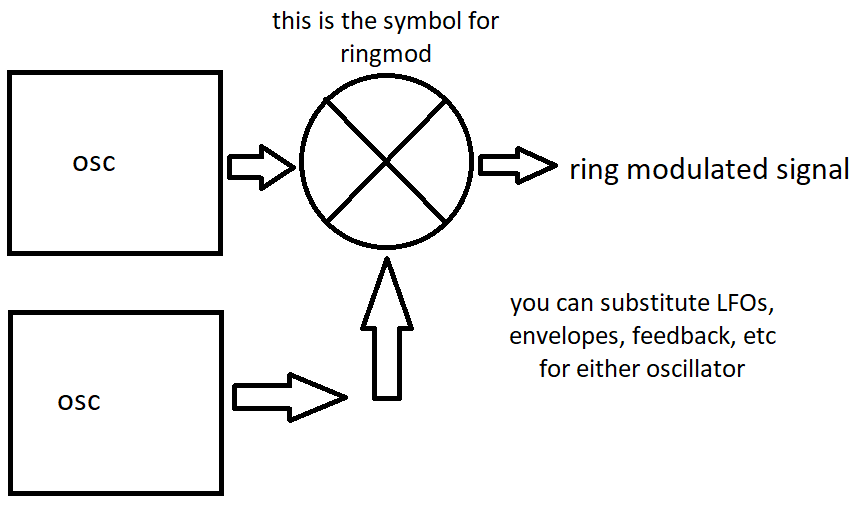
Post Script
some patch ideas (from an earlier post):
-simplest thing is to take 2 waves from the same osc and ringmod them together to make a new wave (and how i get the Xaw wave on my oscillators)
-next is to take 2 oscillators tuned to harmonic intervals and ringmod those
-do that but also try syncing the two oscillators
-don’t try to ringmod chords though. like plaits chord mode? doesn’t ringmod well unless it’s like octaves or fifths – incidentally, the above audio example uses additive oscillators which do tend to be ok with ringmod)
-ringmod inharmonic stuff to make even more inharmonic stuff. i do this a lot with noise and vocal/animal noises, makes neat results.
-remember it can be a vca with unipolar modulation, so you can do am stuff too
-math! it’s a multiplier, so you can multiply 2 signals with varying degrees of accuracy depending on the ringmod
-inverter! basically, negative multiplication, modulate with a static negative voltage
-combine modulation in weird ways! remember envelopes are unipolar so you can am cv, or use unipolar things like lfos and offset envelopes
-distortion! some ringmods can overdrive depending on design
pulsar/vosim
Hello and welcome to the seventh synthesis techniques challenge! In this weekly series we’re exploring the myriad of ways one can synthesize sound, starting simply and getting more complex as we go. There’s no prizes or anything, these are just so you can better learn your tools and maybe learn some new things in the process.
This week, we’re exploring one of the newest methods of synthesizing sound: pulsar synthesis. While most synthesis methods we use now are based in tech from the 20th century, Pulsar synthesis was first published in 2001 by Curtis Roads but implemented first in 1991 then again but improved in 1999 by Alberto De Campo, and is built upon 2 basic principles: impulse generators (think Mannequins’ Mangrove) and amplitude modulation synthesis. It holds similarities with those and ring modulation synthesis explored last week.
At its most basic, Pulsar synthesis is amplitude modulation synthesis of any signal by any other signal. More specifically, those signals should be phase locked (not hard synced) such that they start at the same phase; they should be tonal rather than atonal (so an actual wave instead of noise); and the modulation signal should have an obvious period of silence within the total period of the waveform which can be varied. Multiple modulation signals with lower frequency than the period may be employed for a unique smearing effect, and they can be of differing shape. It gets more advanced from there which you can read about in the original paper here: https://static1.squarespace.com/static/5ad03308fcf7fd547b82eaf7/t/5b75b1181ae6cfab10991421/1534439741265/SoundCompwithPulsars.pdf (this also covers potential musical uses if you’re into that)
TL;DR, start with 2 sine waves that start in phase and are integer ratios of each other and have one amplitude modulate the other, and go from there. Modulation and subtle external effects like light reverb are open. Have fun, and I’ll have a new one next Friday!


an easy trick with this one is actually to use an impulse generator as the modulator. impulse generators should probably get their own challenge, but it’s a simple concept:

granular/particle noise
Hello and welcome to the eighth synthesis techniques challenge! In this weekly series we’re exploring the myriad of ways one can synthesize sound, starting simply and getting more complex as we go. There’s no prizes or anything, these are just so you can better learn your tools and maybe learn some new things in the process.
This week, we’re finishing up what’s effectively been a 3-week series on modulating amplitude in weird and fun ways by delving into my most-used version thereof: granular synthesis. Granular, as I think most of y’all know, involves taking input audio, cutting it up into tiny bits of audio (grains), and playing them back with various grain shapes and spacing. What you may not know is you can do granular synthesis with enough VCAs and LFOs!
There’s a lot of ways to think about granular. Some people think it’s only about samples, some people say it’s a purely digital process but can be done with live audio and a continuous buffer, but our old friend from last week, Curtis Roads, tells us in an article from 1988, “granular synthesis involves generating thousands of very short sonic grains to form larger acoustic events. The technique can be classified as a form of additive synthesis, since sounds results from the additive combination of thousands of grains.” Now, that tells me 2 things: 1) this is very resource intensive, and 2) it doesn’t really matter how we generate the grains. He does further detail more exact specifications for grain shape, size, and goes as far as to say each grain can have its own duration, waveform, and amplitude, which simply isn’t practical for most applications. As such, I’ll leave this pretty open. You can use as many or few grains as you want, with what ever shapes you want, as long as a cohesive sound is created.
Modulation and subtle external effects like light reverb are open. Have fun, and I’ll have a new one next Friday!
additive
Hello and welcome to the ninth synthesis techniques challenge! In this weekly series we’re exploring the myriad of ways one can synthesize sound, starting simply and getting more complex as we go. There’s no prizes or anything, these are just so you can better learn your tools and maybe learn some new things in the process.
This week, we’re doing more maths stuff with additive synthesis! Despite what you may have heard, additive synthesis has precisely one definition: the summation of elementary waveforms to create more complex waveforms. In modern use, this is achieved through sine waves, however it’s been a thing for centuries in the form of pipe organs, which are very much non-sinusoid generators.
Now, before you go about just mixing any waves together willy nilly and saying it’s additive synthesis, we’re specifically going to employ harmonic addition, which means setting individual harmonics to varying levels to create the sounds we want. Harmonics are integer multiples of the fundamental, so if you have a 100Hz base frequency, the harmonics would be 200, 300, 400, etc. Technically speaking, most additive synths will employ partials, which are non-integer multiples and thus allow for inharmonic partials as well as harmonic partials. This is how you get truly powerful waves from additive synthesis, and is why so many additive synths employ macros: there’s just too many parameters!
So, for this week, I want you to find yourself some sine waves, or an additive synth (mode 5 green on plaits works) and create yourself some neat waveforms! Normally I limit extra stuff to light effects and open modulation, but this time I actually encourage the use of wavefolders, after you’ve got the concept of additive. It really opens a wide world for you to explore. Have fun, and I’ll have a new one next Friday!
Post Script
quick example using phaseplant’s “harmonics” unison option, which plays detunable harmonics (thus, partials). With some clever modulation we can accurately replicate the initial impact, quick dissipation of energy, and gradual resonance decay of a bell using just sine wave amplitude manipulation via macros.

concatenative synthesis (wavestation)
Hello and welcome to the tenth synthesis techniques challenge! In this weekly series we’re exploring the myriad of ways one can synthesize sound, starting simply and getting more complex as we go. There’s no prizes or anything, these are just so you can better learn your tools and maybe learn some new things in the process.
Today we’re covering something you’ve probably never heard of: concatenative synthesis. You’ll start to understand what this means if I then say “it’s what the Korg Wavestation and Wavestate use”. Concatenative means to link things together in a chain or series. In this case we’re linking together samples in length from 10 milliseconds up to 1 second to create a sound, be it cohesive or more… sequenced. Its original use was with speech synthesis, stringing together phonemes to create words, but it’s since reached the mass music market thanks to Korg and, albeit at a much less mass quantity, sequential switches and scanners which allow you to string together different sounds to create a single sound.
So, how do I want you to go about this? A few ways, depending on what you have available. The first and most true-to-form would be a sampler that can chain together multiple samples, such as a Wavestation/Wavestate. Another, more analogue method, would be to use a clocked sequential switch or scanner with the outputs of an oscillator to create a wave sequence. Please note this is not the same as a wavetable, though the similaries at least for single-cycle concatenation are there. It’s also not vector synthesis specifically, though most vector synthesizers do employ a form of concatenative synthesis.
You’re allowed to use whatever modulation and light effects to taste. Have fun, and I’ll have a new one next Friday!
PS: this is the same concept Klavis is using for their new filter! Also, quick dumb example of what that can sound like (all sounds from a single Korg wavestation without multitracking):
2osc subtractive (serge)
Hello and welcome to the 11th synthesis techniques challenge! In this weekly series we’re exploring the myriad of ways one can synthesize sound, starting simply and getting more complex as we go. There’s no prizes or anything, these are just so you can better learn your tools and maybe learn some new things in the process.
This week, I want to delve a bit more into the Serge style of synthesis. Unlike the east vs west coast debate, Serge was like “why not both?” and not only combined the various signal types into one cable format (which so far was separated, with east coast having triggers/gates separate from other signals and west coast separating cv and audio) but then included aspects of each coast in one. This sounds normal now, but in the 70s this was some serious black magic fuckery witchcraft.
Now, the more astute synthesist might ask, “Ava, Serge has no style, it’s designed for experimentation and learning!” While that is correct, and while Serge is designed to be patch programmable rather than a static synth, we can examine patch examples in various published manuals to see what the basic layout would be: 2 oscillators, one FMing the other with FM amount controlled and/or augmented by an external CV source, ring modulated together, waveshaped, filtered, then sent into a set of VCAs for panning/fading/dynamics management. Noise, delay, FFBs, frequency shifters, binary logic, and more are all available, as well as a slew of modulation options thanks to the power of USGs.
You’re allowed to use whatever modulation and light effects to taste. Have fun, and I’ll have a new one next Friday!
P.S. Some patching ideas to get you started:
-Slew limiters can act as envelope generators when fed a gate. In this sense, they are attack/sustain/release, or ASR, envelopes. If the gate is shorter than the attack time, you’ll get a quieter envelope. They can also act like strange lowpass filters and envelope followers.
-Feeding that into a sample and hold will allow you to hold the rise or fall at any point for any length of time, thus allowing for an ADSR, AHDSR, and similar envelopes.
-Using a ground-referenced comparator or built-in End of Cycle (EoC) output, you can get any envelope to oscillate like an LFO by patching the resulting trigger signal back into the envelope trigger/gate input. You can use this to get variable slope (saw to tri to ramp) and PWM signals.
-use a sample and hold to make arpeggios and sequences by using a clock that is a multiple of an LFO or envelope’s total time, and sampling the LFO or envelope with said clock.
-VC slew limiters can be used to make slides between notes at certain steps, or make variable square to triangle waveforms.
-ring modulators can act like VCAs
-use crossfaders, ring modulators, or even dual VCAs with an inverted CV signal as switches to go between two signals by modulating them with a square wave. This can be used as a form of soft sync if the two signals are inverses.
-use comparators to make digital noise sources for dank retro game noises
-use EoC and EoR outputs to trigger other envelopes. This can be used for quadrature generation or, if used with switches, wacky modulation signals.
-modulate your waveshaper. also feed back into it.
-phasers can be used as comb filters and doppler effect generators
and for our more visual users:

fm part 2
Hello and welcome to the 12th synthesis techniques challenge! In this weekly series we’re exploring the myriad of ways one can synthesize sound, starting simply and getting more complex as we go. There’s no prizes or anything, these are just so you can better learn your tools and maybe learn some new things in the process.
OK, let’s try this again: FM synthesis, this time simpler. This has been called the most complicated and hard to use synthesis method, and that’s because it deals with something we don’t often play with directly: phase. Frequency modulation is changing the base frequency, or how often something happens. Amplitude modulation is changing volume. Phase modulation, what FM synthesis is all about, changes when something happens. It’s a close emulation of exponential analog FM when using sine waves, but easier to calculate for computers. However, it gets far more interesting when you get other waves involved, but we’ll gloss over that whole can of worms.
For this, I just want you to use basic 2-op FM using sine waves. Plaits green 3 is a classic example of this. Several synthtech oscillators can do this. Most every FM synthesizer, like a DX7, Dexed, Phaseplant, Opsix, Digitone, and more can do this. However, if you only have a basic analog modular system, you can still do it – with a trick (below).
You’re allowed to use whatever modulation and light effects to taste. Have fun, and I’ll have a new one next Friday!
————————-
Using a VCF with LP and HP outputs, run a sine wave into the input and another sine wave into the cutoff CV input, preferably through a VCA to modulate FM amount. Invert one of the filter outputs, and mix it with the other. This will subtract the two. This turns the filter into a basic phase modulator, with some colour depending on topology, and resonance works as a feedback control. You won’t get as deep modulation as you will with a digital system, but the concept is still true.

wavetable
Hello and welcome to the 13th synthesis techniques challenge! In this weekly series we’re exploring the myriad of ways one can synthesize sound, starting simply and getting more complex as we go. There’s no prizes or anything, these are just so you can better learn your tools and maybe learn some new things in the process.
This week we are exploring wavetable synthesis! This technically includes a wide variety of things, but to simplify and keep in line with the majority of wavetable synths and implementations out there, we’re going to define wavetables as “a series of ‘frames’ of waveforms creating a set that can be morphed or selected between in order”. The cool thing is these waveforms can be anything, from algorithmically calculated to sample-derived, and even can create entire synth voices including dynamics and timbre changes, so just sweeping through the wavetable gives you a lowpassed saw stab (if that’s your thing, see attached. also useful for seeing how wavetables work, and shows the phase shift lowpass filters apply to signals).
Editor’s note: Squarespace doesn’t allow .wav uploads, so I havent included the wavetable file in this archive.
There’s a lot of modules that do wavetables, including plaits (green 6), quadnic (without interpolation), many synthtech modules (we’re not counting E330), scanned, orgone accumulator, etc. Please note that while sonically wavetables can be similar to waveshaping, FM, vocal, and other synthesis methods, it is different on a technical level. For further information, I wrote an article on wavetables: https://www.avarethtaika.com/how-to-make-noise/wavetables
You’re allowed to use whatever modulation and light effects to taste. Have fun, and I’ll have a new one next Friday!
kick drum
Hello and welcome to the 14th synthesis techniques challenge! In this weekly series we’re exploring the myriad of ways one can synthesize sound, starting simply and getting more complex as we go. There’s no prizes or anything, these are just so you can better learn your tools and maybe learn some new things in the process.
Today we’ll be talking about the basics of drum synthesis: the kick drum. There’s actually a lot of ways to synthesize kick drums, depending on what you’re looking for. From filter pinging with modulation and distortion to using a VCO, VCA, and decay EG to modulate pitch and amplitude and even FM synthesis, the myriad of methods is too many to list in a single message. I’ve attached a .txt if you want to read more about exactly how to synthesize kicks in a wide variety of ways. Of course, we can combine any and all of these techniques.
The general idea, however, is to create a low-pitched decaying sound, preferably using a sine or triangle wave, with a strong attack. Despite typically being a music thing, kick drums are useful for a variety of things, including impact noises, explosions, even exciters for resonators.
It’s very easy to use an entire System 55 just to synthesize a kick drum. Experiment! Use the attached .txt to get patch ideas. If you upload clips of music, be sure to make the kick prominent in the mix. Have fun, and I’ll have a new one next Friday!
Post Script
The classic method is actually just filter pinging: send a short trigger to a resonant filter, often a bridged-T bandpass filter, and it will oscillate with a punchy attack (the click) and a nice bassy decay (sinusoid waveform). Most any resonant filter will work for this though. If you use two filters tuned about a 5th apart, you get the 606 kick. They will decay at different rates, emulating the harmonic changes the sound goes through. You may have also done this with BI/A.
You can build upon that pinged filter concept by adding a decay envelope, also triggered, and using it to modulate frequency of the filter. This makes the sound much punchier and is a classic sound for EDM kicks. If you add variable feedback to make it longer or shorter, filter and clip the trigger to a nice click sound, and lowpass the output, you get the 808 kick drum.
However, we can get WAY more interesting (and complex) than that. For example, we can use a decay EG to modulate pitch of a triangle VCO, which is synced to the trigger. We can then clip that triangle to get a sinusoidal waveform. We can clip the envelope as well to get a compressed drum envelope, which when paired with the distortion yields hefty, huge-sounding kicks. We can then mult the trigger signal into a lowpass then bandpass to create a nice click to add punch to the attack. We can add in some lowpassed noise to this click and modulate that combined signal with a VCA and a shorter decay EG to get a nice, complex, combined sound, very much like the 909 kick drum.
However, there’s yet more very fun ways to make kick drums that can really spice up your ~~sex life~~ darkcore ambient techno 3.5hr live sets. For example, we can use a simple additive synthesizer (or FM synth as an additive synth) with 6 partials with ratios of 1 through 6. We can get a more realistic sound by detuning the partials in a tilted fashion such that lower ratios are tuned lower and higher partials are tuned higher, and changing decay time with frequency such that higher frequency = faster decay. This is something BI/A excels at, actually, given it’s a 6-partial additive synthesizer with variable ratio and decay based on frequency.
If you don’t have that, another great trick is to use a slightly up-shifted frequency shifter on a triangle VCO to generate extra harmonics, then run that through a decay EG-controlled VCA. In fact, you can run any basic shape through a VCA controlled by a decay EG to get a kick drum sound. Bonus points for modulating frequency with said EG and clipping the VCA.
Finally, we can use FM synthesis. This is where something like Opsix can really shine, because we can use a 2-op FM pair into a bandpass filter to synthesize the mid frequencies of a kick, mix that with a lowpassed frequency shifted triangle oscillator, run those into a distortion and control volume with a decay EG. With a more traditional FM synth, you can do the same thing but use 5 operators, 2 as an FM pair and 3 in a stack, using the third operator as the frequency shifter-esque device, and control the final output with a decay EG.
vector synthesis
Hello and welcome to the 15th synthesis techniques challenge! In this weekly series we’re exploring the myriad of ways one can synthesize sound, starting simply and getting more complex as we go. There’s no prizes or anything, these are just so you can better learn your tools and maybe learn some new things in the process.
This week we’re doing something very few of you can do properly – sorry – but is very cool: vector synthesis! It’s technically a form of concatenative synthesis, but limited by 4 sound sources on an xy pad or joystick, which can be modulated/sequenced. To do this, you need 4 sound sources and some form of XY mixer for them. Traditionally, the 4 sound sources can be wavetable oscillators (prophet vs), samplers (wavestation, so including sample sequences and loops), or fm voices (sy22), but can technically be any source (oasys).
The XY part is crucial, ideally done via joystick, but can be emulated with a JAG or similar system. Using Frames or other multi way crossfaders can technically do this, but are limited to the sequence you program and how you modulate it. ideally you’ll use a joystick for this because it’s really the only proper way to do it (that i know of).
You’re allowed to use whatever modulation and light effects to taste. Have fun, and I’ll have a new one next Friday!
impulse generator
Hello and welcome to the 16th synthesis techniques challenge! In this weekly series we’re exploring the myriad of ways one can synthesize sound, starting simply and getting more complex as we go. There’s no prizes or anything, these are just so you can better learn your tools and maybe learn some new things in the process.
Today we’re effectively doing seemingly everyone’s favourite things: filter pinging. But, we’re doing it with a twist: at audio rate. You see, a filter is a resonant object. When you excite a resonator, it will vibrate. Filters do the same, hence filter pinging. But, did you know you can ping filters at audio rate to do what’s called impulse synthesis?
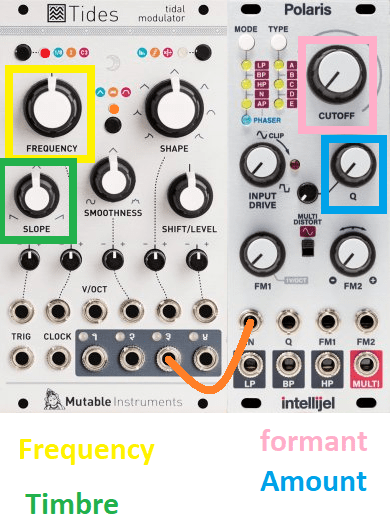
This one’s real simple: take a really thin pulse wave and plug it into a (preferably multimode) filter. Crank up the resonance up until it almost, but doesn’t, self oscillate. Congrats, you’re doing impulse synthesis! You now have 4 primary controls: frequency, timbre, formant, and amount (osc frequency, pulse width, cutoff, and resonance). You want the pulse width to be less than or greater than 50%, preferably in the 1-25% or 75-99% ranges. Playing with these four controls, or sequencing them, will give you vocal formants, woody basses, 303 noises, and more!
You’re allowed to use whatever modulation and light effects to taste. Have fun, and I’ll have a new one next Friday!
filtered noise/basic resonator
Hello and welcome to the 17th synthesis techniques challenge! In this weekly series we’re exploring the myriad of ways one can synthesize sound, starting simply and getting more complex as we go. There’s no prizes or anything, these are just so you can better learn your tools and maybe learn some new things in the process.
You’ve heard of lowpassed saws. You accidentally highpassed a triangle once. Now… you’re gonna bandpass some noise! MUAHAHAHHA no seriously we’re filtering noise this week but it’s not as boring as it sounds 🙂
Filters, as you likely know by now, are typically resonant devices, using a feedback loop to emphasise the cutoff frequency to the point of self-oscillation. Running a signal into a self-osc or nearly self-osc filter will almost always yield interesting results, but if that input signal is noise, you can use that to create a very simple resonator. The noise will continuously excite the resonant network that is the filter, allowing for vocal sounds, waves crashing, and more. A noise burst will give you a nice percussive sound, starting with a lot of frequencies and quickly decaying to a single frequency, the filter cutoff. Employing multiple filters of multiple types can work wonders as well, but given most people don’t have multiple filters, we’ll save that for later 🙂
BTW if you remember waaaaaay back to when we did contests before, we had a thing where we all made songs from noise. Same concept!
You’re allowed to use whatever modulation and light effects to taste. Have fun, and I’ll have a new one next Friday!
karplus resonator
Hello and welcome to the 18th synthesis techniques challenge! In this weekly series we’re exploring the myriad of ways one can synthesize sound, starting simply and getting more complex as we go. There’s no prizes or anything, these are just so you can better learn your tools and maybe learn some new things in the process.
I’m genuinely surprised I haven’t really gotten into resonators yet in this series, given most of my work deals with them. Last week, we used a basic filter as a resonator. While that has its uses, a much more employable resonator is the Karplus-Strong resonator. Rather than using filters, this method uses an audio rate delay with a lowpass in the feedback loop to create plucked string sounds when fed a noise burst. When fed constant noise, you get a bowed string sound. When fed… other… stuff, you get… well, I’ll leave that experiment up to you 🙂
Most delays have a lowpass in the feedback loop anyway, so if yours goes to audio rates, you’re set for this – just watch your feedback amount as it can and will blow up your speakers and ears if you’re not careful. If you don’t have a delay but do have a Rings, good news! While slightly more complex than Karplus-Strong, the normal red mode of Rings is effectively just a highly expanded upon Karplus-Strong resonator. Feel free to uh… y’know that jack you never use that says “in”? Try using that for this 🙂
You’re allowed to use whatever modulation and light effects to taste. Have fun, and I’ll have a new one next Friday!

modal resonator
Hello and welcome to the 19th synthesis techniques challenge! In this weekly series we’re exploring the myriad of ways one can synthesize sound, starting simply and getting more complex as we go. There’s no prizes or anything, these are just so you can better learn your tools and maybe learn some new things in the process.
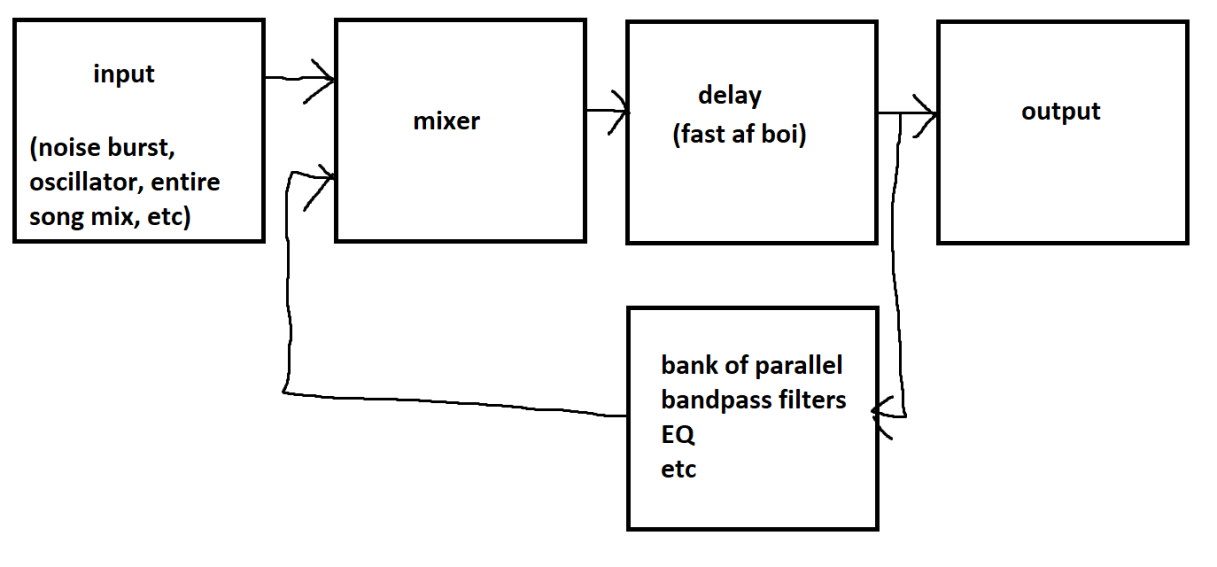
Week 3 of resonators cuz they’re fun! This week, we’re doing the literal exact same thing as last time, except we’re replacing the lowpass filter with a whole-ass bandpass filter bank where each filter has adjustable Q, cutoff, and volume, preferably at least 8 but more is better. This is called a modal resonator, because each filter emulates a mode of a physical object. A mode is where natural resonances meet and determines how an object sounds when it’s struck, like a wooden bar, metal tube, plastic sheet, etc. Modal synthesis is the combination of complex exciter source and modal resonator to create physical sounds (yes, this is a form of physical modelling synthesis).
If you have MI Rings or Elements, you’re set for this, just use green mode on rings and normal mode on elements. If you have a 1970’s analog modular synth (or just a delay and 8+ band EQ), run your delay to a mult and split the signal between your output and your EQ module. You can also use multiple bandpass filters in general to do this (4 is the easiest for most people probably, which will be more formant filter and less modal filterbank but should suffice to learn the concept).
You’re allowed to use whatever modulation and light effects to taste. Have fun, and I’ll have a new one next Friday!
digital noise generation
Hello and welcome to the 20th synthesis techniques challenge! In this weekly series we’re exploring the myriad of ways one can synthesize sound, starting simply and getting more complex as we go. There’s no prizes or anything, these are just so you can better learn your tools and maybe learn some new things in the process.
This week, we’re covering something i use daily and you should too: digital noise! digital noise is effectively random pulse waves, but there’s a lot of ways to create that and they all sound different.
The easiest would be to put a comparator on a noise source, creating a random pulse train. This would be excellent, except most people don’t have basic utilities like comparators in their rack. You can also sum 6-8 highly detuned pulse waves, which is how old drum machines made the noise required for cymbals… but most people don’t have 6 spare oscillators. Most people do have a shift register in their rack, however, and those can also spit out a random pulse train when clocked at audio rate. Bonus points for using a linear feedback shift register! If you don’t have any of that, you can also run noise through an extremely heavy distortion. This will create a hard clipped noise, which is similar to random pulses.
Feel free to experiment with other ways to make random square waves! I would prefer we focus on creating the sound this time, so minimal/no modulation and effects please. Have fun, and I’ll have a new one next Friday!
multi-filter stuff (formants, telephone, EQ, resonator, complex osc)
Hello and welcome to the 21st synthesis techniques challenge! In this weekly series we’re exploring the myriad of ways one can synthesize sound, starting simply and getting more complex as we go. There’s no prizes or anything, these are just so you can better learn your tools and maybe learn some new things in the process.
Today we’re talking about fun stuff you can do at home with 2 (preferably identical) multimode filters! That’s right, all you Blades users (and I guess other dual filter plebs), this is your post.
The first and most obvious thing is called a telephone filter. It’s when you run a highpass (at 400hz) into a lowpass (at 4000hz). This gives you the same frequency range as most phone signals up until the recent invention of HD calls. You can vary the distance as well as transpose the filters to your liking to make a variable bandpass filter, which is also useful. Add resonance and you can also get twin peaks going.
Speaking of twin peaks, if you set both filters to bandpass and run them in parallel instead of series, you can mostly create a formant filter! Set one with a max range of 200-900hz and another to 500-2600hz. Control the cutoffs with a joystick and you’re creating formants! You can use other filter types as well, but you’ll just get more twin peaks stuff and less formant stuff.
With a mixer, you can use the lowpass and highpass filters as an EQ. Run them in parallel, control gain of the two channels with the mixer. Set resonance to about .7 Q, or no obvious peaking. Or you can say fuck that shit, crank the resonance, and voila, you built yourself a resonator! …yes this is basically filter pinging but with 2 filters.
Speaking of cranked resonance, you can just treat them like oscillators and have one modulate the other. cutoff is FM, mode (for blades) is PM, resonance is AM. Throw a wavefolder after and you dun did bild urslef a complex osc.
You may use any modulation and light effects. Have fun, and I’ll have a new one next Friday!
cymbals
Hello and welcome to the 22nd synthesis techniques challenge! In this weekly series we’re exploring the myriad of ways one can synthesize sound, starting simply and getting more complex as we go. There’s no prizes or anything, these are just so you can better learn your tools and maybe learn some new things in the process.
Hatssststststs
hats r kewl
let’s make some
The basic hi hat sound is literally just a quick decay envelope modulating the amplitude of white noise. Could also use blue noise, but THAT SHIT’S FOR FUCKIN ROOKIES so instead let’s use a massive array of square waves. Mix together 6 highly detuned squares (or pulses), like to the point they make a crazy metallic chord, and you’ll get a nice noise sound which works great for short cymbals, like hats. Bonus for mixing that with noise.
We can expand on that idea by using square wave resonators, which are like karplus resonators but use inverse feedback to create a sound that’s more square-like than saw-like. Feed an array of these resonators a white noise burst and y’all dun did gitcherself a hat (or longer cymbal but this is mainly about hats). You can also just use a metallic resonator, like in rings, to make a roughly hat-like noise as well (again when fed a white noise burst).
Yaaaaay now you can synthesize hi hats! Have fun, and I’ll have a new one next Friday!
snare drum
Hello and welcome to the 22nd synthesis techniques challenge! In this weekly series we’re exploring the myriad of ways one can synthesize sound, starting simply and getting more complex as we go. There’s no prizes or anything, these are just so you can better learn your tools and maybe learn some new things in the process.
Do you remember when we made bass drums? And last week we made hi-hats and cymbals? Welpppppppp today we’re combining those and making snare drums!
specifically, if you mix a drum sound with noise, be it digital, white, etc., you basically get a snare drum. I know. Should probably have been more creative. It’s fine.
Yaaaaay now you can synthesize the 3 cornerstones of percussion! Have fun, and I’ll have a new challenge next Friday!
modulation mixing
Hello and welcome to the 23rd synthesis techniques challenge! In this weekly series we’re exploring the myriad of ways one can synthesize sound, starting simply and getting more complex as we go. There’s no prizes or anything, these are just so you can better learn your tools and maybe learn some new things in the process.
This week we’re transitioning less into actual synthesis methods and more into patching technique. We start with the simplest: modulation mixing. Predictably, this is when we mix multiple modulations together to create a complex modulation source. In this case, we will be modulating an oscillator (but this will work on anything with a cv input).
Start with a sequence. Any sequence. Preferably the Yoshi’s Island theme as found on the original NTSC release of the game for SNES. Using any mixer, add a short inverted decay envelope to each note, so it quickly bounces up in pitch. Congartz u just mixed modulation gg no re
OK no but seriously you can mix a lot of modulations. Using that same mixer, assuming enough inputs, add an LFO for vibrato. Now you have a sequence with bouncy and wiggly notes. You can also add another source, say an attenuated knob outputting a constant voltage, for pitch bend. Ideally you would use a precision adder for this one so you get precise bends (usually +-2 semitones). You can also add a second sequence to that, again with a precision adder.
Anyway, that’s how you can mix 5 modulation sources together to create highly interesting sequences. Have fun, and I’ll have a new challenge next Friday!
modulate modulation (bouncing ball, fm, env time with lfo, vca)
Hello and welcome to the 24th synthesis techniques challenge! In this weekly series we’re exploring the myriad of ways one can synthesize sound, starting simply and getting more complex as we go. There’s no prizes or anything, these are just so you can better learn your tools and maybe learn some new things in the process.
This week, we’re playing with modulation again, but this time we’re working with the concept of modulating modulation, though it’s worth noting today’s and last week’s prompts work with audio as well. The most common form of modulated modulation is via a VCA. This allows you to control the amount of modulation with another signal, such as from the mod wheel, but can also be used to control an LFO fading in to control vibrato over time.
However, a more fun form of modulated modulation is frequency/time modulation. This is when an LFO controls decay time to make pluckier sounds turn into more open sounds over time. You can also FM two LFOs together like you would two VCOs to get complex yet repeatable modulation sources. Modulating LFO time with an envelope is also very useful, especially in SFX design, but can also create fun risers/downers. You can also use this to create the classic bouncing ball patch with a DUSG-style device.
Experiment, have fun, and I’ll have a new challenge next Friday!
modulation interactions (rm, phase mod, analog logic, offsets)
Hello and welcome to the 25th synthesis techniques challenge! In this weekly series we’re exploring the myriad of ways one can synthesize sound, starting simply and getting more complex as we go. There’s no prizes or anything, these are just so you can better learn your tools and maybe learn some new things in the process.
In episode 3 of “How to Use Simple Modulation Creatively with Avareth Taika”, we’re gonna delve deeper into modulation interactions, basically ways you can manipulate one modulation source with another to get a more complex modulation source. A simple example you’ve likely seen often is ring modulation of two LFOs, which works just like ringmod with VCOs but it’s really low frequency. But we can do waaaaay wackier stuff!
…You ever just phase modulate a modulator with another modulator so you get modulated phase modulation modulation? I do rather often because it’s super useful! Unlike phase modulation like you may hear in a DX-7, phase modulating a low frequency source like an LFO or even an envelope allows you to effectively remap the signal, adding folds to transients of envelopes by phase modulating with an LFO, or creating classic FM waveshapes but for modulation purposes (yes, this means you can indeed modulate your donk with a donk for ultimate donkitude). BUT WAIT, THERE’S MORE!
If you call in the next 30 minutes, we’ll also include analog logic and offsets! Analog logic allows you to process transient signals, effectively giving you the positive or negative portions of any signal, audio or modulation. This means you can create wacky clipped LFOs by ANDing with an envelope, get a randomly bouncing signal with two sine LFOs OR’d together, or – and here’s a fun trick – split any modulation signal in half based on positive or negative, then offset each by the maximum value in the opposite direction. Offsetting is just mixing a signal with a DC voltage, opposite meaning if you have an OR’d signal with a peak of +5V, offset it by -5V to make it entirely negative. If you then mix the two offset signals together, yo get some… pretty wacky signals lol (See pic)
Have fun, and I’ll have a new challenge next Friday!

modulation shaping (folder, shaper, precision shaper, USG, filter, slew)
Hello and welcome to the 26th synthesis techniques challenge! In this weekly series we’re exploring the myriad of ways one can synthesize sound, starting simply and getting more complex as we go. There’s no prizes or anything, these are just so you can better learn your tools and maybe learn some new things in the process.
In episode 4 of “How to Use Simple Modulation Creatively with Avareth Taika”, we’re gonna explore shaping modulation. This is where you apply a waveshaper to modulation. The most obvious method would be to distort or wavefold a modulation signal, the first squaring off the peaks, the second folding the peaks inwards, possibly multiple times.
You can also use a precision waveshaper, AKA remapper, to change where different parts of the signal go (i.e. make positive negative, fold, clip, rip the midpoint out and into the peaks, etc). Klavis Flexshaper is a great example of this. Using a slew limiter (or USG as a slew limiter) is excellent for smoothing modulation signals. Filtering modulation, especially lowpass filtering with resonance, allows for very unique slewing with bounciness.
Have fun, and I’ll have a new challenge next Friday!
 Taika Sound Design
Leave a comment