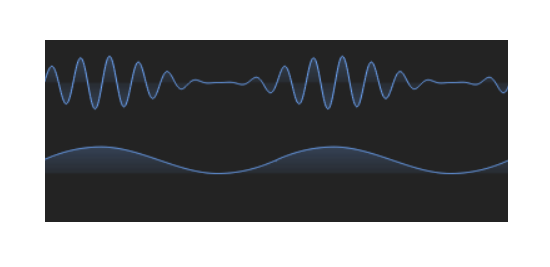
Using two sine waves of equal frequency, the resulting multiplication creates a shape that looks like a soft-clipped rectifier, effectively folding the negative part of the wave up. Increasing carrier frequency will start getting into Microsounds territory, effectively granulating the carrier with a single stream. I use a simple trick with a quad VCO, quad VCA, and a single source multed to all four VCAs to create an analog pseudo-granular effect.
Similar to AM is RM, or ring modulation. It does the same thing (and is the default for PhasePlant, so use custom wavetable modulators with no negative portion to accurately do AM with that), except when the modulator goes negative, it actually inverts the carrier. Ring modulation has been used in the past as a method of distorting military radio signals (and famously used as the voices of Daleks), but has many other uses besides. Some patch notes:
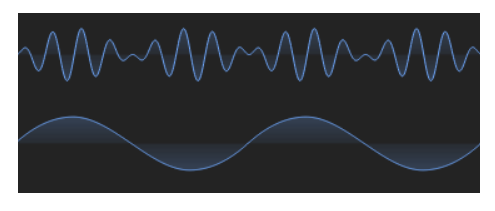
Ringmod has very different results. Again using sines of equal frequency, the carrier will double in frequency but halve in amplitude. Increasing modulator frequency creates almost FM synthesis-like waveshapes. At very high modulator frequencies or slightly increased carrier frequencies, the output will become more Microsound-esque, but at double the frequency of AM due to not cutting out half the wave. Interestingly, due to this inversion property, ringmod can also be used for soft sync when the carrier is a square wave of lower frequency than the carrier; at equal frequency, the carrier is full-wave rectified, and when the carrier is of lower frequency, you get unique waveshaper-esque outputs ripe for complex filtering.
Frequency
Frequency modulation or FM (not to be confused with FM synthesis, more on that later, but can be confused with radio FM because it’s the same thing) is quite simply changing the frequency of something. As stated before, an LFO can create vibrato in small amounts, but also an envelope can make a punchy percussive sound or help make a fun sync lead, and another oscillator can create everything from absolute chaotic noise to unique timbres. Because FM literally changes the core frequency of an oscillator, this isn’t typically used when you want to maintain a specific tuning regime. There’s generally two forms of FM, linear and exponential.
Linear FM is typically used for things like vibrato and sync leads. There’s a linear 1:1 ratio of input signal vs output signal. With identical sine carrier and modulator signals, you’ll get a sort of asymmetric wavefolding sound and waveform. As the modulator increases in frequency, the modulation will become more chaotic until very high frequencies, where the carrier can overcome the relatively weak-power modulator and you end up with a sort of “lo-fi” carrier. However as the carrier increases in frequency, you basically just get a more pronounced “folding” effect. In the below image the modulator is actually rectified, which is more a weird quirk of Phaseplant than anything.

Exponential FM is more what you use for pitch control, like from a sequencer, as well as making punchy percussive noises. At audio rate modulation, it’s also what FM Synthesis was largely based upon, though that’s a slightly tweaked version of exponential FM that we will, again, get into later. Input signals are multiplied exponentially, hence the name, meaning with identical sine carrier and modulator signals, you’ll actually get a sort of squeezed and stretched waveform. This is because as the modulator signal rises, it’s actually rising increasingly higher, modulating much greater with higher amplitude. A higher carrier frequency will create a combination of sync and fold sound, whereas a higher modulator frequency will actually result in a pleasing, almost bitcrushed sound as the output actually does become a stepped wave. If you use AM as described above, you can have an envelope control FM amount from modulator to carrier, and you’ll quickly hear FM synth-like sounds, except that tuning is all over the place.
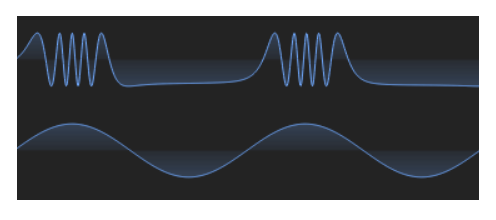
This is because of multiple factors. First, the modulator is literally modulating frequency and thus base tuning, at audio rate. Second, as oscillators rise in frequency, their effective power or percieved volume drops, thus changing the amount of modulation as frequency changes. Third, when modulating the modulator with an envelope, for example, the amplitude of the modulator is further changed with the envelope. This all works against you and your lovely tuning because the core frequency is being changed in all sorts of crazy ways. So, it was decided we wanted this sound, but with good tuning. And thus, phase modulation was born.
Phase
Basics first: phase is when something happens. You can think of it like a fast delay with no feedback and 100% wet mix: you simply change when the sound plays. If you modulate that delay, such as with a chorus effect (or flanger if you add feedback), you can hear the sound seemingly rising and falling in pitch. This is due to the delay buffer constantly changing size and stretching or squeezing the waveform – much like with frequency modulation, because it effectively is that. You also hear it when a moving object goes past you via the Doppler effect, like an ambulance siren rising in pitch as it comes towards you and lowering as it goes away, or a whoosh from a sword starting lower in frequency and going higher towards the middle of the swing and back down. None of these are actually changing the frequency of the source material, they are an added effect that can cause a perceived change in frequency.
Most synths cannot modulate phase, except those capable of FM Synthesis. To condense a lot of history, John Chowning from Stanford University created FM Synthesis by trying new ways to synthesize sound and settled on phase modulation which was then licensed to Yamaha who reworked it for musical purposes because mathematically it has the same timbre as exponential FM but retains tuning, and then released the GS-1 and, later, DX7, which we all know and love (and they also licensed the tech to the Synclavier but whatever). That mathematically similar aspect looks slightly different on an oscilloscope, but the sound is the same: identical carrier and modulator will create a much more symmetric and cleaner waveform. With a higher modulator frequency, instead of a bitcrushing effect you’ll get a combination folding and sinusoidal wave. A higher carrier frequency will actually result in a more linear FM-like waveform.

You may notice that phase modulation sort of straddles the line between AM and FM as amount changes; hence, the DX7 algorithm is often likened to a modified quadrature AM setup, aka ringmod, but more akin to what Opsix and Serum call ringmod than actual ringmod. It gets weirder when we get into more advanced uses of phase modulation, such as warping, stretching, phase distortion (a whole other synthesis method based on phase modulation but from Casio), or even just other basic shapes. Let’s review those now at a sort of high level because this gets weedy real quick and I already wrote a slightly deeper article on that here.
Warping, aka bending, is when you use phase modulation to change the midpoint of an oscillator’s waveform. For example, using a wavetable reminiscent of an inverting lowpassed saw wave (so fade from lowpassed saw to nothing to inverted lowpassed saw), we can bend a wave, for example a saw wave, to be more sinusoidal rather than linear between peaks. Below you can see this visually:

Stretching, sometimes called sync in wavetable synths, is similar to warping or bending, but uses a unipolar saw that gets inverted and flipped through zero to achieve its effect. The nd result, especially with more complex waves, is that parts of the wave get stretched out as others shrink to make room within the cycle. At the midpoint the wave is unaffected, as with warping, but as the modulator amplifies you can see how the wave stretches:

“But Ava,” I hear you ask, “these look very distorted, what makes Phase Distortion special?” Alas, technically almost all phase modulation is indeed distortion, but phase distortion is also a specific synthesis method that’s basically a subset of phase modulation that I like to call window shaping. If you’ve ever used something like Serum’s custom distortion editor, WMD’s Geiger Counter, or even a Casio CZ series synth (where phase distortion synthesis was commercialised), you’ve played with phase distortion. It can also be seen as a remapper like the old Oberheim Matrix remapper, but instead of changing amplitude as the input signal is amplified, phase is modulated as amplitude of the input signal rises. This means you can do everything from saturation and folding to completely transforming waves relatively easily, as long as you have the right modulator wave 🙂
Oh and finally, FM Synthesis as we now know is actually phase modulation, and sounds like exponential FM with sines but stays in tune. But… what about doing FM synthesis with shapes other than sine? Weeeeeell that’s kinda where the whole FM thing falls apart. You see, because we’re modulating phase, things react weirdly with fluctuations in signals, so if you were to, for example, modulate a sine with a saw wave, you’d get a sync effect instead of a rising frequency effect:
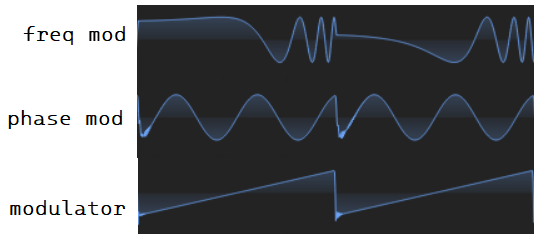
This is true with all the basic shapes, too: square will split the sine in half and change phase of each half, and triangle will cause a sharp wavefolding effect. Where this gets really weird is when you use complex shapes like wavetables, especially if you combine techniques from above by mixing a warp wavetable with a decaying sine wavetable to modulate a noisy wavetable, you can very quickly get everything from 2014 dubstep to monster yowls and interesting percussion. Oh, and because you can phase modulate anything, you can perform these bending, stretching, and other things to samples as well!
Conclusion
Hopefully it’s now clear what differentiates FM, PM, and AM. I’m also not the best at explaining things generally so if this makes no sense, drop a comment below and I or another member of our little coven here will hopefully sort you out.
 Taika Sound Design
Leave a comment