This article is both an explanation and a hope for the future of granular synthesis. I put a big ol’ line between the two topics, like this one:
Granular synthesis. Just the term alone conjures up a sense of intrigue, as if hinting at a hidden world of sonic wizardry waiting to be unlocked. And indeed, granular synthesis is a fascinating technique that has captivated sound designers, offering a vast realm of possibilities for creating rich and complex textures. So, let’s delve into the granular synthesis realm, uncover its inner workings, discover some creative patch ideas, and ponder the future of this transformative sound design tool.
I’ve dug a bit into granular synthesis before, especially in my Monsoon/Clouds article, but lets start a little more simply and explain exactly what granular synthesis is, how it works, and how it can be used to make neat noises.
At its core, granular synthesis is a method of manipulating sound by dividing it into tiny grains or particles. Each grain typically lasts only a few milliseconds but can be as long as several seconds, though that kinda starts defeating the idea of granular as you get longer. By controlling parameters such as grain size, density (from vastly spaced out grains to several grains overlapping), and position in the source material, we can transform ordinary sounds into extraordinary sonic landscapes.
How does it work? Well, imagine taking a sound wave and breaking it down into countless microscopic fragments. Each grain contains a small snippet of audio data, and when played back in rapid succession, these grains merge to recreate the original sound. By adjusting the properties of these grains, we can manipulate the sound in captivating ways.
One of the primary parameters in granular synthesis is grain size. Smaller grains tend to produce more transient, percussive effects, while larger grains lend themselves to evolving, atmospheric textures. Experimenting with grain size can yield fascinating results, transforming a simple sound into a complex and evolving entity.
Density is another crucial parameter. It determines the number of grains playing simultaneously. Higher densities can create dense, swirling textures, akin to a sonic cloud, while lower densities allow for more spacious and sparse soundscapes. By modulating the density over time, one can create dynamic and evolving textures that constantly morph and evolve.
Positioning grains in time offers another avenue for exploration. By staggering the starting point of each grain, we can create rhythmic patterns or introduce randomness, leading to unpredictable sonic results.
Without overlapping, this is pretty much all attainable by controlling amplitude of a signal with a rectified LFO. Multiple LFOs controlling multiple amplitude lines of the same signal allows you to overlap. Thus, in a modular environment, we can replicate granular synthesis like this:
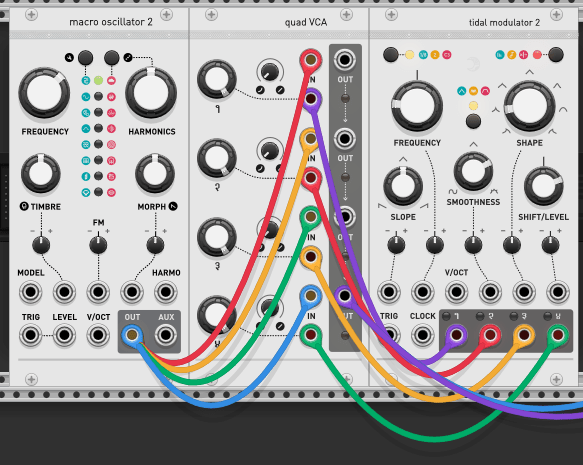
In this example, we’re using plaits as our sound source, sending it to 4 VCAs, each of which is modulated by a differently timed LFO from Tides v2, mixed, and output. If you try it you’ll find you get instant classic granular sounds. Fun, right?
In the patch above, we’re already getting some interesting alien UI noises. In my Monsoon/Clouds article linked above, I went into a few other patch examples for footsteps, gravel, etc. Now, let’s delve into how granular could expand.
Now that we understand the basics of granular synthesis, let’s consider some patch ideas that showcase the versatility of this technique, outside of examples already provided in other posts.
Ethereal Pad Generator: Take a simple, sustained sound and feed it into a granular synthesizer. Experiment with longer grain durations and densities to create a rich and evolving pad sound. Apply subtle pitch modulation and add a touch of reverb for an otherworldly atmosphere.
Glitch Percussion Ensemble: Load a percussive loop into a granular synthesizer and experiment with moderate grain durations and high densities. Randomize the grain starting positions to introduce glitchy and unpredictable rhythms. Process the result with distortion, filtering, and delay for a chaotic and gritty percussion ensemble.
Time-Stretched Ambience: Take a field recording of natural sounds, such as flowing water or birdsong, and stretch it using granular synthesis. Apply long grain durations and low densities to create extended, dreamlike atmospheres. Add subtle pitch shifting and granular reverb for an immersive sonic experience. Algorithms like Paulstretch is great for this as well, as they often employ granular techniques.
As we look to the future of granulation in synthetic sound design, exciting possibilities emerge. Advances in computing power and real-time processing allow for more complex and intricate granular engines, as we’ve seen in Iridium, Opsix, and more recently, Phaseplant, enabling designers to push the boundaries of sonic exploration.
One area of development lies in incorporating machine learning techniques into granular synthesis. Imagine a granulator that can analyze audio and video or in-game events in real-time, identifying relevant parameters and granulating a library of samples automatically. This would provide a new level of sonic interaction, freeing sound designers to focus on artistic expression rather than technical details – useful when you’re on a time constraint!
Additionally, the integration of granular synthesis with virtual reality and augmented reality platforms holds immense potential. By harnessing the spatial nature of these technologies, sound designers can create interactive sonic environments that respond to the user’s movements and interactions, which would be excellent both in interactive media such as games as well as audiovisual events like product showcases.
In conclusion, granular synthesis remains an intriguing and versatile technique for sound design. By understanding its inner workings, experimenting with different parameters, and exploring the vast sonic landscape it offers, musicians and sound designers can unlock endless possibilities. And with the future promising even more advancements, us alchemists of sound are poised to embark on an extraordinary journey of sonic exploration!
 Taika Sound Design
Leave a comment